Rose Colored Glasses
Does perspective change how we treat others? Should it? Or should we act in a Christ-like manner no matter what?

Take a moment and imagine yourself in the following scenario:
You are alone or with one other person traveling to your destination.
The scenery around you is unfamiliar. You don’t recognize the neighborhoods. You don’t see many people that look like you. You feel like an alien in a strange land.
Before you enter, you look up and see walls. Are these walls going to protect me? Are these walls trying to keep me out? How much money did they spend for these walls anyway?
Upon entrance, there may or may not be people to greet you. You may get directed to where you need to go, or you may have to wander before you know your next step.
There are symbols that tell you what this place is about. There is a clear allegiance.
There are political signs that you don’t know what to make of. Am I supposed to agree with this? Will I get in trouble if I disagree?
You start to feel self conscious and wonder if you are wearing the “appropriate clothing” to be accepted in this place.
You are greeted by some and stared at by others. Is this what it means in the Scripture when it says, “Love your neighbor as yourself?”
Where are you? (Go ahead and take a guess.)
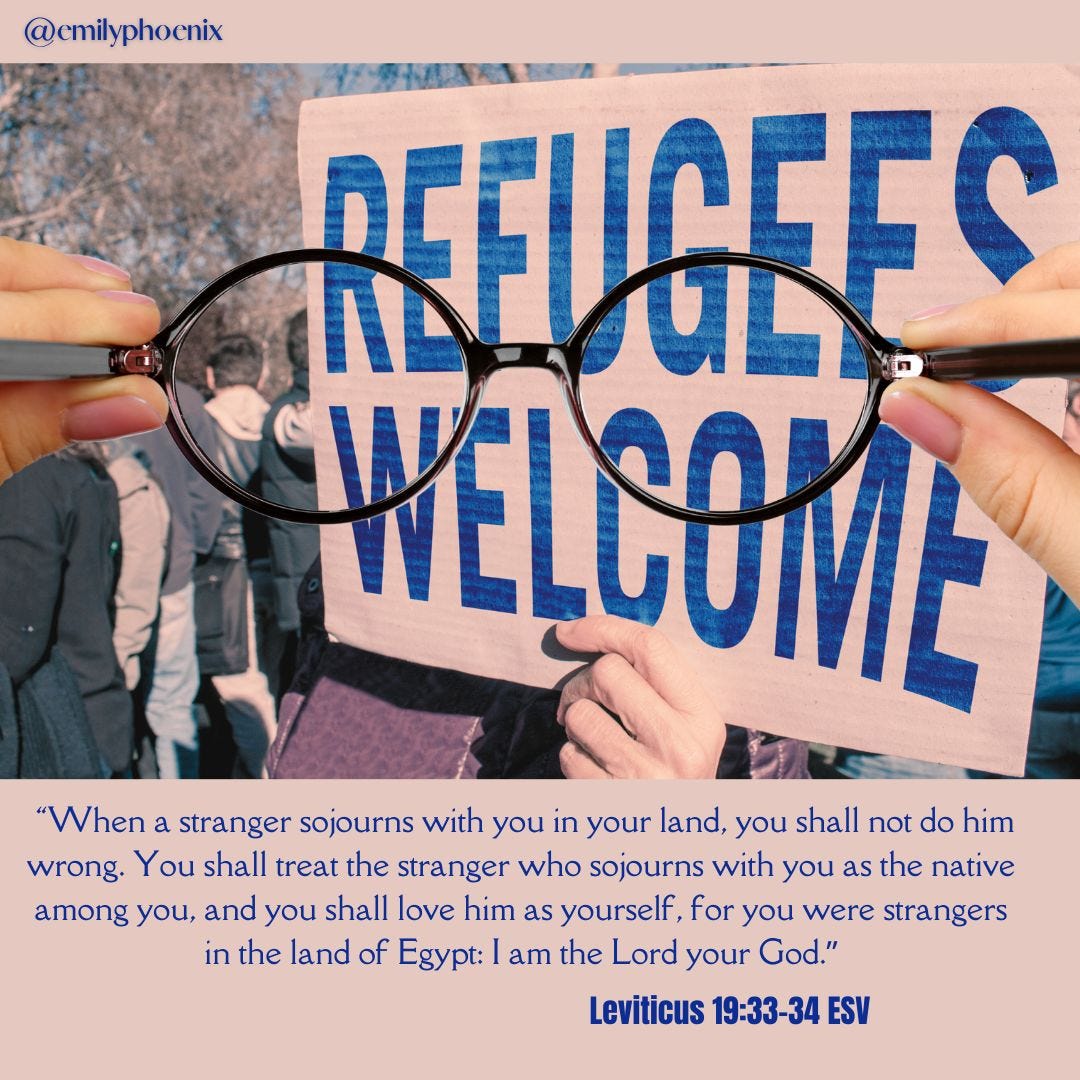
Perhaps you are a refugee from the south, crossing the border into the USA?
Or are you a faithless refugee walking into a building where worship, Bible study and other activities take place?
Or is it both?
How does this scenario change your perspective? Does it make assumptions about these places that are unintended? Does it cause you to pause and see it through a blood-colored lens instead? Does it make you want to act differently towards your neighbors?
This passage from Leviticus is often one we reference when we talk about immigration. But what if it applies to the stranger that enters our church buildings?
The truth is we were all once strangers to God, sinners in need of a Savior. But God sees us through the blood colored lens that show Christ’s sacrifice and death for our salvation.
I’ve never been at a border crossing, but I have walked into religious spaces with loved ones who are spiritually lost. And as many times as I have done this, I am still surprised and caught off guard by how uncomfortable it is for those individuals.
How do we treat spiritually lost refugees? Do we make assumptions about the baggage they bring as they enter? Do we welcome them with open arms, regardless of how they look or are dressed?
Are the words, “Come as you are,'‘ scrolled across your church website, really true, because I know someone who may disagree based on their own experience. And is that phrase practiced regularly or are the only ones entering your space already comfortable?
We are capable of creating welcoming spaces that are truly for everyone.
We just need to remember who Jesus is, who we are (broken, sick and in need of forgiveness, just like any other person), and the Good News we want to share!
Whether it’s a refugee that recently crossed our country border or came through the entrance of the church, seeking sanctuary:
Will you set aside your comfortability to welcome the refugee?
Will you drop your desire to stare and judge and instead greet and ask?
Will you ask what would make the space more easily accessible?
And will you do it all in the name of love, remembering that God first loved us?