Speaking up matters.
Honoring sisters during Women's History Month

I’ve been humbled by all the subscriptions I have received in the last month and thankful for the recommendations!
As much as I wish I would have a more regular pattern of posts on a weekly basis, the content and timing of my posts are truly Spirit-led (with only a touch of procrastination). You should see how many draft posts I have that just sit until God inspires me to write more!
I recently learned a story from the Bible that I had not recalled reading before. It’s in the book of Numbers, which is probably why I don’t remember it. But, separately, I am also reading a book about women in church leadership throughout history, so I took a closer look at it.
One day a petition was presented by the daughters of Zelophehad—Mahlah, Noah, Hoglah, Milcah, and Tirzah. Their father, Zelophehad, was a descendant of Hepher son of Gilead, son of Makir, son of Manasseh, son of Joseph. 2 These women stood before Moses, Eleazar the priest, the tribal leaders, and the entire community at the entrance of the Tabernacle.[a] 3 “Our father died in the wilderness,” they said. “He was not among Korah’s followers, who rebelled against the Lord; he died because of his own sin. But he had no sons. 4 Why should the name of our father disappear from his clan just because he had no sons? Give us property along with the rest of our relatives.”
5 So Moses brought their case before the Lord. 6 And the Lord replied to Moses, 7 “The claim of the daughters of Zelophehad is legitimate. You must give them a grant of land along with their father’s relatives. Assign them the property that would have been given to their father.
8 “And give the following instructions to the people of Israel: If a man dies and has no son, then give his inheritance to his daughters. 9 And if he has no daughter either, transfer his inheritance to his brothers. 10 If he has no brothers, give his inheritance to his father’s brothers. 11 But if his father has no brothers, give his inheritance to the nearest relative in his clan. This is a legal requirement for the people of Israel, just as the Lord commanded Moses.”
-Numbers 27:1-11 NLT
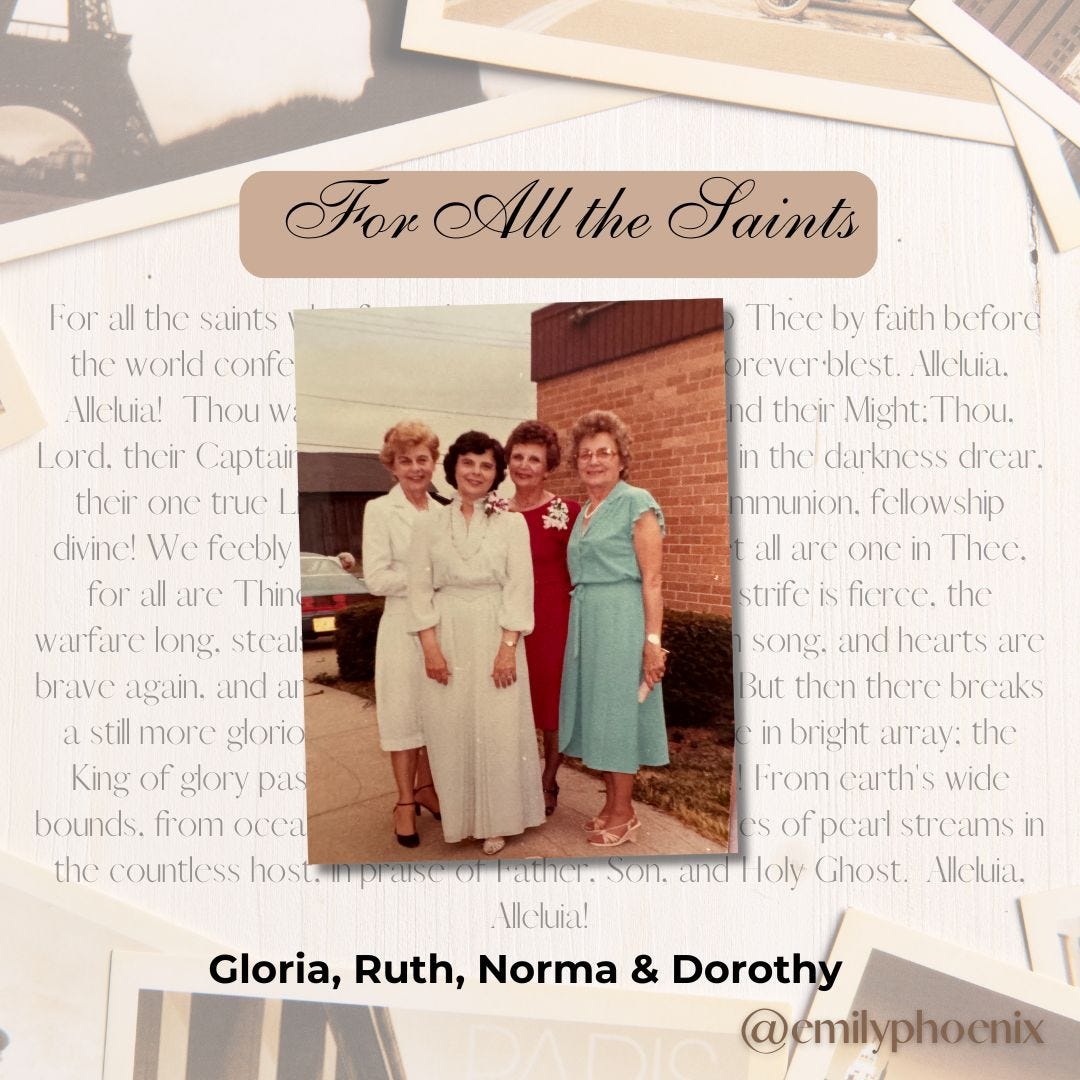
This story reminded me of four sisters (Dorothy, Norma, Gloria and Ruth) who lived long and faithful earthly lives. From what I know of my grandmother, Dorothy, and her sisters, I think they would have taken a similar path that these five sisters did, because while they did have a younger brother, who would have carried on the family name, he was the first sibling to die.


My grandma, Dorothy, would be 104 this month. It’s wild to me that it has already been 15 years since she died.
She was the oldest child of a pastor, the wife of a pastor, and the mom of a pastor. She shared her faith openly and with others in her words and actions. Although I didn’t know her sisters as well, I very much heard they lived that way also. And while I never met my great-grandparents, I can imagine their children standing up for what belonged to their family, just as the daughters of Zelophehad did. They were close knit and even though they lived across the country from each other, they shared a Christian faith.
Since March is Women’s history month, let us remember the women we know, the women we came from and the women that paved the way for us long ago, even if we don’t know their names.
I know there are many lessons to learn from women: in this story from Numbers, from my family, and from all corners of the world.
Five sisters stood before the the leaders and the entire community to present a petition - what a sight that must have been, and perhaps took much courage by these women!
We get a lot further when we work in unison with one another. Not just our blood family, but as brothers and sisters in Christ. To share faith with others is a gift to appreciate.
These daughters desired to honor their father and also recognize that the law did not address their own family regarding who inherits land ownership.
When laws are broken or need to be changed because they are unfair, speaking up matters and it does make a difference
Moses took this request seriously, because he didn’t just consult with the tribal leaders, he brought it to God.
Do we listen when someone speaks up? This story tells me that the earthly leaders took it seriously and presented it to God. What can we learn from this?
How does God respond? He validates the claim of these women and says the law needs to be changed for the future.
What matters the most is that God sees and hears and cares for everyone. These daughters saw an injustice, brought it before authorities and God validated it.
How is women’s history shaping you for the future? Today launched a podcast miniseries called All the Buried Women. I look forward to learning more names and stories of ordinary women who were simply living out their callings from God to love him and love their neighbor.
Speaking up matters, and God listens.
I love this.
I started a read of the whole Bible a few years ago and then got hung up on Leviticus. (I really need to give it another go.) One of the things that struck me about Leviticus was how much of the law laid down in the book was for the good of the people. It wasn't as much about strict moral code as it was about teaching the Israelites how to live in fruitful community with each other. The laws were designed for human flourishing in an unforgiving environment. This reality gets lost in discussions about strict, literal readings of the entire Old Testament.
This story has resonated with me since I first came across a few years back. I love that you tied it to your Grandma and her sisters. The lessons you drew from it encourage me to learn more about the faithful women who've benefitted me by standing for their God-given inheritance.