Let's Not Be Silent
There's a host of issues that the Church does not speak up about, but if we are about "loving our neighbor," then we need to start with being present and truly listening to those around us.

This is part of a series, sharing the self-authored book, “The Hard Way: Honest Conversations about mental health in our homes, churches and communities,” which is introduced in this free post as well as this one. The funds given by paid subscribers for this post will be donated to the Open Path Collective.
I long to see you so that I may impart to you some spiritual gift to make you strong—that is, that you and I may be mutually encouraged by each other’s faith. —Romans 1:11-12 (NIV)
What does it look like to care for those struggling with their mental health in our churches (and yes I mean the people, not the buildings)?
When we come to worship, Bible study, or a church function, there isn’t always room for our brokenness. It’s hard to be vulnerable and take off the “everything is great” mask. Oftentimes it’s easier to pretend that everything is great.
The real tragedy for discussion of mental health issues, and many other issues, is the church’s silence.
Do we hear about it from the pulpit? In some cases, perhaps, but it’s rarely the norm. Do we study Elijah, Jeremiah, and the many other Bible narratives that speak to the raw emotions that come with difficult situations?
Do we provide gatherings and seminars where Christians counselors can share resources? We offer workshops on finances, retirement, and parenting—but what about mental health?
When mental health issues come up in the church, it’s often amongst friends in safe spaces, rather than publicly because of our fear of poor reactions. We may be encouraged to see a Christian counselor, and while appropriate, it still removes the discussion from the heart of our Christian communities.
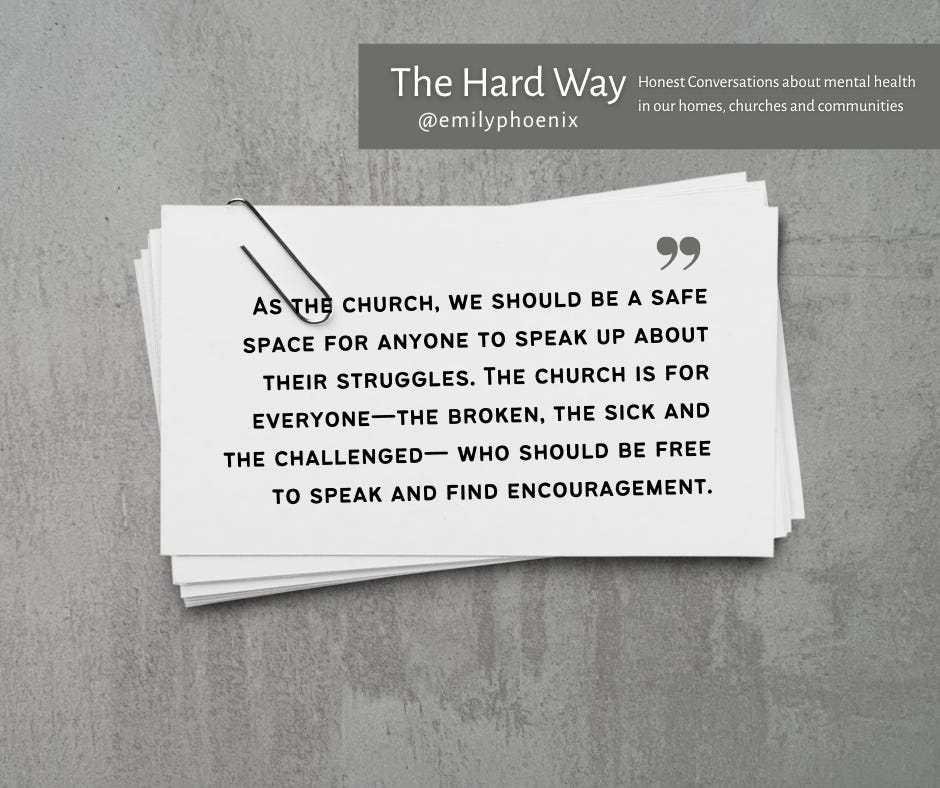
As the church, we should be a safe space for anyone to speak up about their struggles. The church is for everyone—the broken, the sick and the challenged— who should be free to speak and find encouragement. It’s not a country club where everyone pretends life is perfect.
So what does this look like? How can we slow down the busy pace in our own churches and be present with one another? How can we make the space for people to feel safe enough to speak up when they need help?
A ministry of presence is an important tool I’ve learned in recent years. This is the ability to be available and present with those who need it. It requires listening, caring, and praying for those who show up to our Christian communities. It means being aware of what’s going on with your neighbor or being present enough to check in with your local grocery clerk. It’s a way of life, not just something to practice among friends.
In the Gospel we see that Jesus ministered to both friends and strangers—he did not discriminate. He made space for anyone who wanted to be near him. If we are to live Christ-like lives, we should strive to connect with those around us in deep and meaningful ways.
It takes time, but isn’t this our purpose?
What about those who work in the church? We minister, but who ministers to us? We have to seek out our own safe spaces with each other, Christian counselors and family. This is not easy, but I am thankful to surround myself with professionals who are not only colleagues, but true friends.
Even as I continue to mourn a friend whose life ended in suicide, I am reminded of his own ministry of presence to me. I am motivated to share in that same ministry with those around me, checking in and praying for those who experience the joys and challenges of working for the Lord.