The Future is Now
The Impact of mental health conversations on younger generations.

This is part of a series, sharing the self-authored book, “The Hard Way: Honest Conversations about mental health in our homes, churches and communities,” which is introduced in this free post as well as this one. The funds given by paid subscribers for this post will be donated to the Open Path Collective.
As we consider traveling the path of the Hard Way, we have to remember the generations that come after us and the impact mental health conversations have on their lives. Often we hear the sentiment, “children are our future,” but the reality is that the future is now. In this moment, our words and our actions impact younger generations. We each have the responsibility to model how to talk about difficult life circumstances and allow the space for Gen Z and Alpha to explore their own struggles.
A number of factors make mental illness a growing issue among younger generations than in previous generations. We live in a time of economic stress, lack of access to healthcare, mass shootings (many in our children’s schools), humanitarian crises, and an overemphasis on being successful.
While the advancement of technology has given us many new opportunities to learn and improve our skills, any tool we have can be used for harm as well. Bullying isn’t just happening within the walls of a school, but it continues through social media platforms. The desire to be liked and sat with at lunch isn’t just happening at school, but it carries over into text message conversations and social media posts at all hours and days of the week. Technology has increased the number of relationships we can have while simultaneously reminding us that we are not enough.
The entertainment value placed on tragedy and death is an additional factor. We have glorified death in all its forms, making it more accessible to those who seek a way out of difficult situations. We have downplayed the importance of face-to-face communication and eliminated the spaces for kids (and adults) to speak up when they need help.
Suicide is a difficult enough topic to discuss when it happens amongst adults, but there is a growing epidemic of young children taking their own lives at an alarming rate.
“Suicide is the 10th leading cause of death in the U.S., and the 2nd leading cause of death for people aged 10–34.” NAMI.org
What makes an elementary aged student die by suicide? How does one that young even know how to harm themselves?
Why do the middle school bullies win out, wreaking havoc on the emotional health of one student, who then spirals into a depressive state?
Where is the community for that college student who feels isolated enough to try and end his life?
It’s clear that we have to talk about mental health and continue to take steps to remove the stigma. It has to be normal for children to get both physical and mental health exams before each school year. Health education must include mental health professionals speaking to children and giving them and their parents coping mechanisms in challenging times.
“Since 2009, physicians have been encouraged to perform general depression screenings for children aged 12-18…Screenings and discussions with adolescents are vital in preventing them from resorting to self-harm or suicide to achieve relief from distress that can be effectively treated.”
-NAMI, “Nami Releases Family Guide On Adolescent Depression,” Dec 20, 2010.
National Alliance on Mental Illness (NAMI) has a number of wonderful free resources to be used to talk about mental health One particular called “Say it Out Loud” promotes conversation among youth through the use of personal stories. We have to remember that each statistic that we read is an individual with a story. It’s easy to make a little or big deal about a fact, but when personalized, it becomes relatable.
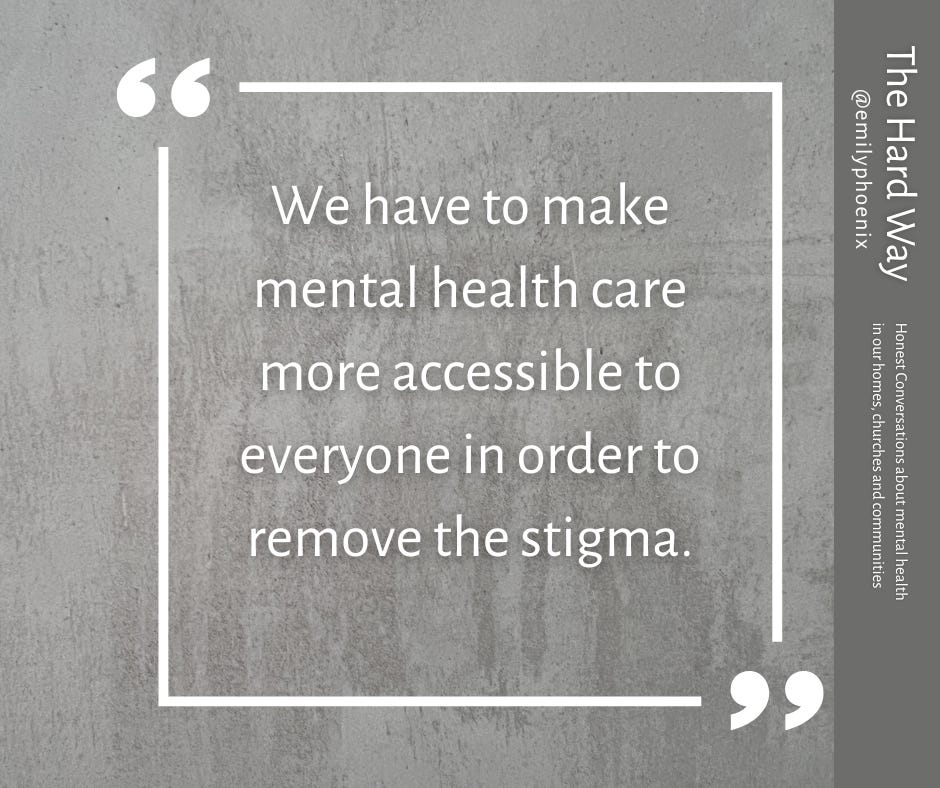
I certainly don’t have answers to the difficult questions posed here, but all of these situations ask us to do better. They cry out for us to talk about how we care for ourselves and one another. They require us to take action beyond just talking about it more. We have to make mental health care more accessible to everyone in order to remove the stigma.
Keep reading with a 7-day free trial
Subscribe to Emily’s Substack to keep reading this post and get 7 days of free access to the full post archives.